
Working his way through college

Working one’s way through a college education is nothing new. Alvin Hansen’s story in the first decades of the twentieth century is, however, remarkable.
Alvin, born in 1887 to Danish-American parents, had quite a struggle to achieve his aims. Whilst he had great encouragement from his mother and grandfather, a retired Baptist preacher, his father and the demands of a homestead farming life provided challenges. The one-room country schoolhouse was close by the Hansen homestead in Daneville, near Viborg, South Dakota. Nonetheless in the winter the snow could be so deep that Alvin’s father had to carry him on his shoulders to make the journey safely. When the weather was more clement the demands of the farming year would take him away from classes, so he regularly failed to complete a full year’s schooling. But he was an able student, listening in on the more advanced lessons for the older children. The school teachers would often board with the Hansens which may have provided further opportunities. However his options remained limited, there was no local high school in Viborg. This was still very much the frontier, South Dakota only became a state in 1889. One of the last major confrontations of the American-Indian wars, the Wounded Knee Massacre, had occurred at the end of 1890 some 300 miles west (relatively close in Midwestern terms). Bison, though dwindling fast, still roamed. In 1893 the Southwestern Railroad, linked the cities of Sioux Falls and Yankton, passing within a mile of Daneville, which prompted the creation of Viborg itself around the station. Alvin was amongst the first in his community to make the 30+ mile trip to the high school in Sioux Falls, and had to convince his father to let him finish. He then became the first student in his area to attend college at Yankton, a small liberal arts school in the New England Congregational tradition. Founded in 1881 it closed in 1984.
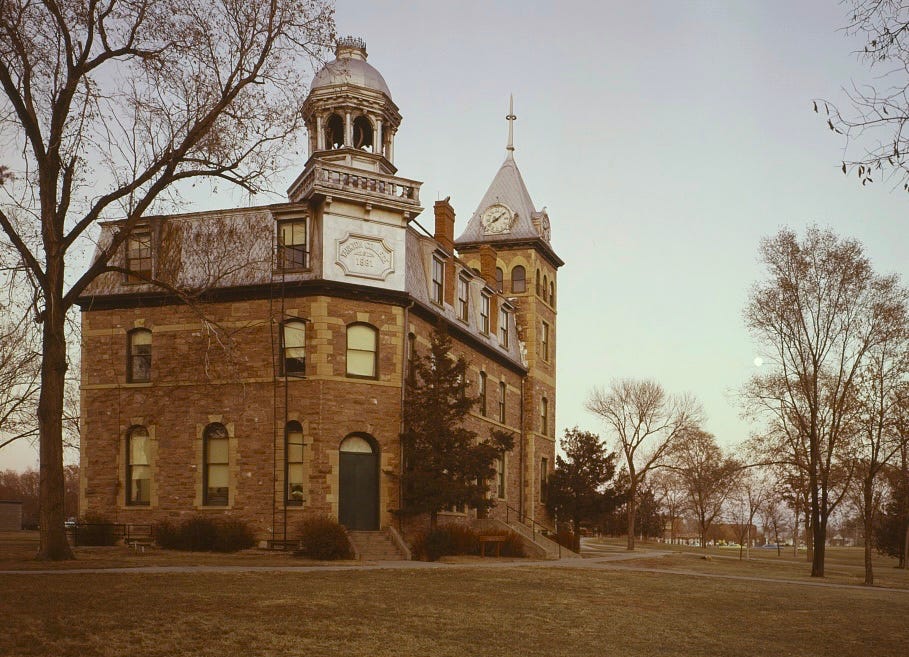
Again, Hansen would prove to be the model student, winning the prize for the most outstanding freshman. Surprisingly, given his later career as an economist, he majored in English and enjoyed participating in the Shakespearean productions. The college later built its own open air theatre, which remains a listed building. If drama is learning someone else’s script then debating is arguing your own on the public stage. Hansen took easily to college debating, and would later coach for both school and college level competitions. Perhaps the first signs of his interest in social and economic issues came in the subject of his oration on “The Tragedy of Lost Childhood” examining the problem of child labor especially in factories and calling for reform. Alvin came second at a state level and then third at the inter-state level (reported in Mitchell Capital 1908-06-05:1 & 1908-06-12:1).
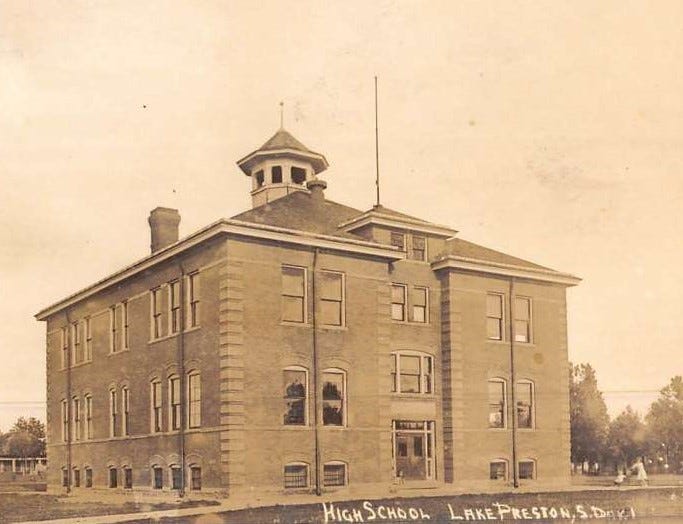
To help fund his undergraduate studies Hansen took a variety of jobs, including milking cows, waiting on tables, and looking after a doctor’s horse. For a short time he even conducted church services, something a number of Yankton students did to earn a little extra money and support nearby communities. Paul Samuelson suggested that he may have done some teaching at this time too. After graduating in 1910, Hansen became a full-time teacher in English and Maths at Lake Preston. Not so much a long-term career move but in order to save enough money to attend graduate school, perhaps in sociology at Chicago, or, as it turned out, economics at Wisconsin. Lake Preston had the added attraction of being the hometown of a fellow Yankton student, Mabel Lewis, who would also return to the area to teach. Mabel had caught Alvin’s eye. Mabel’s father, Ben Lewis, operated the general store in Lake Preston. She was initially hesitant during their courtship, wondering if Alvin had sufficient fire and ambition, so Hansen, needed to prove himself.
Returning to Viborg is the school holidays Alvin would further enhance his college savings fund by taking on yet more employment, alongside the tasks of the family farm and reading voraciously. He wrote to Mabel in August 1911 describing his time as a sales clerk in nearby Worthing, and the surprise of his fellow workers that, for the most part of the year, he was a high school teacher. “Well as to salesmanship I have discovered that the main quality essential to a successful clerk is to be able to bridge the gap between what your customer wants and what you have to offer. To illustrate: If your customer wants a number 6 shoe, and all you have is a 5, then the shoe must be made of leather that stretches readily. … The old Dutchmen around Worthing will believe anything you tell them, and occasionally I made some rather startling assertions which were all well founded in my wide mercantile experience. Wicked, of course, but if its your duty to sell, why then sell you must.“ (letter from Hansen to Mabel Lewis 08.07.1911).
Hansen excelled as a teacher, quickly being made principal and then superintendent of schools (1912-13). Students found him an inspiring and supportive teacher both in the classroom and for the basketball and debating teams he formed. "There was no such thing as a lack of time for either himself or others. It is only those who are hard pressed for time, he would tell his students, who can succeed in life." (Musgrave 1976:2). Saving some $80 a year in this period enabled him to finance his graduate studies at Wisconsin under the leading Institutional Economists, John R. Commons and Richard T. Ely. After finishing his post-graduate coursework, and gaining his MA, he briefly worked as an assistant instructor in economics. Having won Mabel round they married in 1916 in Lake Preston. The Hansens then moved to Providence, Rhode Island when Alvin took up an instructorship in economics at Brown University (1916-1918) whilst still completing his Phd thesis (Viborg Enterprise, 1976-02-19).

On completing his thesis on business cycles, the newly minted Dr Hansen took up a post in 1919 at the newly expanded economics department and School of Business in Minneapolis at the University of Minnesota. By 1924 Hansen had gained promotion to full professor, which increased his salary from $3,500 to $4,000. A decade later in 1936 the front page of Minnesota Chats reporting on the launch of the University’s MBA course, boasted that the university was second to none in Business Administration and had built a reputation as a top school for economic theory thanks to the triumvirate of its professors, Alvin Hansen, Frederic Garver, and Arthur Marget. An unnamed source was quoted “Dr. Hansen is the outstanding economist in the United States today. I have heard it said that this is known nationally, and it is strange that he is not more widely recognized in this home state.”(Minnesota Chats 1936-05-19:1) High praise indeed, and in June 1936 his undergraduate alma mater, Yankton College, awarded him an honorary LL.D. In 1937 Alvin left Minnesota for Harvard, to take up the post of the first Littauer Professor of Political Economy at its new Graduate School of Public Policy. Hansen would become known as the American Keynes and have a profound influence on American social security and post-war economic policy.
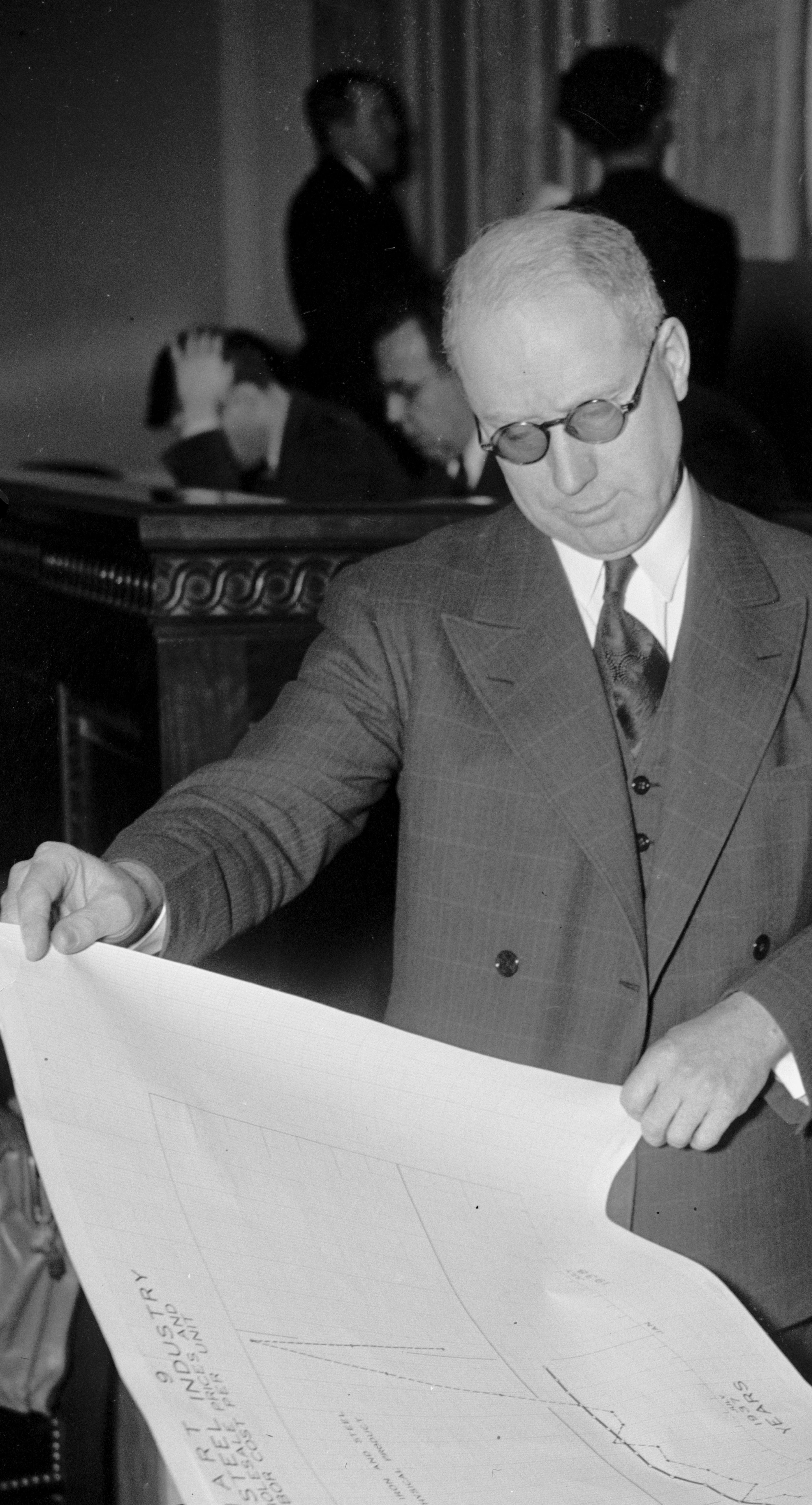
A remarkable story for the farm boy who looked beyond the homestead and the Great Depression to a new frontier of economic possibility, reaching the Ivy League and international renown. Mehrling observed that "Instead of allowing the world to pull him away from Viborg, Hansen devoted himself to making the rest of the world more like Viborg" (1997:88). Throughout his life Alvin, Mabel, their children, and then their grandchildren, returned regularly to the family farm - part of which remained in his ownership until his death in 1975. Mabel died a year later and they were reunited in the Viborg Baptist Cemetery, with his parents, elder brother, and one of his two sisters.
I am hugely grateful for the assistance of Dwight Nelson and Teri Gunderson who have assiduously followed up on comments by Hansen’s grandson, Randall Merrifield, and found the early correspondence between Alvin and Mabel at The Center for Western Studies, Augustana University, Sioux Falls, SD. They have also identified copies of the Viborg Centennial History and other valuable local sources.
Bigg, R.J. (2023) Alvin Hansen: Seeking a suitable stabilization, Cham: Palgrave Macmillan
Hansen, A.H. & Lewis, M. ‘Correspondence 1909-1916’ The Center for Western Studies, Augustana University, Sioux Falls, SD
Mehrling, P.G (1997) The money interest & the public interest, Cambridge, Mass. & London: Harvard University Press
Miller, J.E. (2014) Small-town dreams, Lawrence: University Press of Kansas
Musgrave, R.A. (1976) 'Caring for the real problems' Quarterly Journal of Economics, Feb, XC:1:p1-7
Samuelson, P.A. (1975) 'In search of the elusive elite' New York Times 26 June:39.
Viborg History Book Committee (1992) Viborg, South Dakota : 1893-1993, Viborg SD: Viborg History Book Committee